Sans-IO - Async's divorce with Protocol
When you clicked open this post, an HTTP request flew across the internet towards the machine serving this website. That machine actively listens on your connection by keeping tabs on a FILE.
Yes, you read that right. Its literally a file that the machine is waiting on to read your request.

It is referred to as File Descriptor or FD.
There are thousands of people concurrently reading this post probably. So, we have an FD for each user the machine needs to keep tabs on. You see, its impossible to predict which FD is active to be read and served.
Sounds confusing? Let me throw an analogy.
Imagine you are hosting a party at a hotel with ten doors. As the guest come in, you cannot go around each door one by one looking out to see if you have someone at the door. That’s impractical.
What do you do? You ask your guests to use the calling bell. Well, before that, you need to install a calling bell at each door.
That’s what we do with the FDs too. We register the FD with something called Selector analogous to installing a calling bell on the door. The FDs will come knocking when they have something to say. Now you know the exact door to open to invite the guest in.
So, what is a selector?
To put it bluntly, it is an abstraction offered by the OS that keeps track of all your FDs and its notifications. Each OS has their own flavour of Selector. epoll for Linux. ioctl for Windows and kqeue for MacOS. I wish they all agreed on one and called it a day, but, here we are.
I am going to respect your time and stick to Linux’s version - epoll.
You can ask an epoll to listen on a FD like this
int FD = ... // Obtained through jihad for this example
int epoll_fd = epoll_create1(0); // Create an epoll

struct epoll_event event;
event.events = EPOLLIN; // Monitor for incoming data/connections

epoll_ctl(epoll_fd, EPOLL_CTL_ADD, FD, &event); // Install the calling bell
After this, you ask epoll which FDs are active, it gives you a list, you can now assign your threads for each of these FDs to read the data.
Whichever language you use, you dig through the code deep enough, hooping through the FFI fence, you will see the code something similar to this. We can go on and on about this, but thats for another day.
Loom
Think of this epoll design as a loom. It takes a large spool of FDs and spits out a parseable data for you to read and act on. Once you have this data, then it is business as usual. You process the data and send the reponse back to the client.
Hey wait? Sending a response to client? Can we not ask epoll to write it for us? Yes, we can
What about waiting on a timer till it expires? Yes, we can.
How about waiting on a mutex lock, can it be off-loaded? Yes, we can.
This list goes on and on. But, we dont generally use epoll for all these in a typical software project. Why? Because it is damn hard to get it perfectly right.
People would rather wait on a syscall than to introduce epoll and overcomplicate it. So, when the data comes out of the loom, you no longer need the epoll, it has done its work.
But what if there is a sophisticated and ergonomic way to introduce epoll design in to your code? A bigger loom where you feed spools back into it when you want to yet keeping your codebase sane and simple.
Async Runtime is your answer
We use fancy words like Async to keep the uninformed away and confused. Async Runtime is simply an abstraction that gives you complete access to the underlying Selector.
You might have seen this keyword await often thrown around in a language. Thats literally the user registering an event with the Selector, all hard things abstracted away.
These languages are designed in such a away that the execution is suspended in this await point until the Selector notifies that the event is finished waiting (analogous to data arriving through an FD).
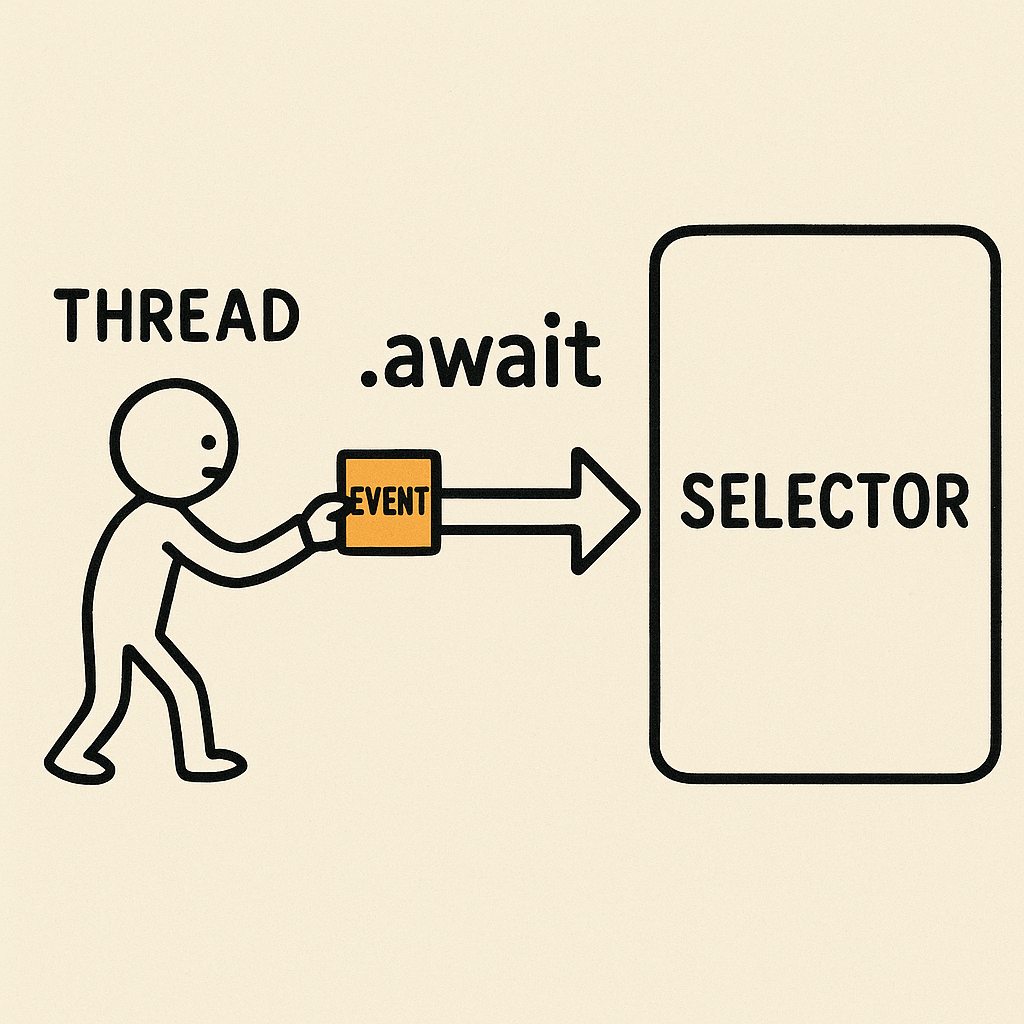
This opens up a brand new paradigm of programming. Any line of code that needs waiting, you slap it with an await and it goes straight to the Selector.
All of a sudden, your threads are happy, they are always executing something instead of waiting on a lock or on a file to be read from disk.
Protocols & Async
As it turns out, protocols with lots of IO (think of HTTP / QUIC) really performs well in this Async model. It is quite obvious because we offloaded all the blocking syscalls to the Selector. We utilize every curve of that CPU cycle enforcing our logic instead of waiting on some IO.
Using Async runtime has shortcomings too. The major one is, once you enter the Async paradigm, it is hard to expose your library to other languages.
Why? Because the language that you expose the library may not understand the Async underpinnings of your code. It may expect a value the moment it calls your function. You have no choice but adhere to it by making blocking calls to your functions defeating the whole purpose of choosing Async in the first place.
Meh, who exposes their library to other languages? A lot of them, especially open source projects. It is incredibly useful if your library can be adapted across languages without any major changes in your code base. It makes a lof of developer lives easier.
Decoupling Protocol Logic & IO
One of the best way to overcome this shortcoming is to implement your library based on Sans-IO design. Sans-IO simply means without IO.
How do people write code without IO? Well, thats not the literal meaning. Let me explain.
When you write your code in the Async world, you might be tempted to throw your protocol, business logic and your application implementation all under a single code base. Sans-IO technique simply involves decoupling of the protocol layer from others void of Async and IO. Your protocol layer simply becomes a state machine that feeds on the IO you give and spits out events for you to act on.
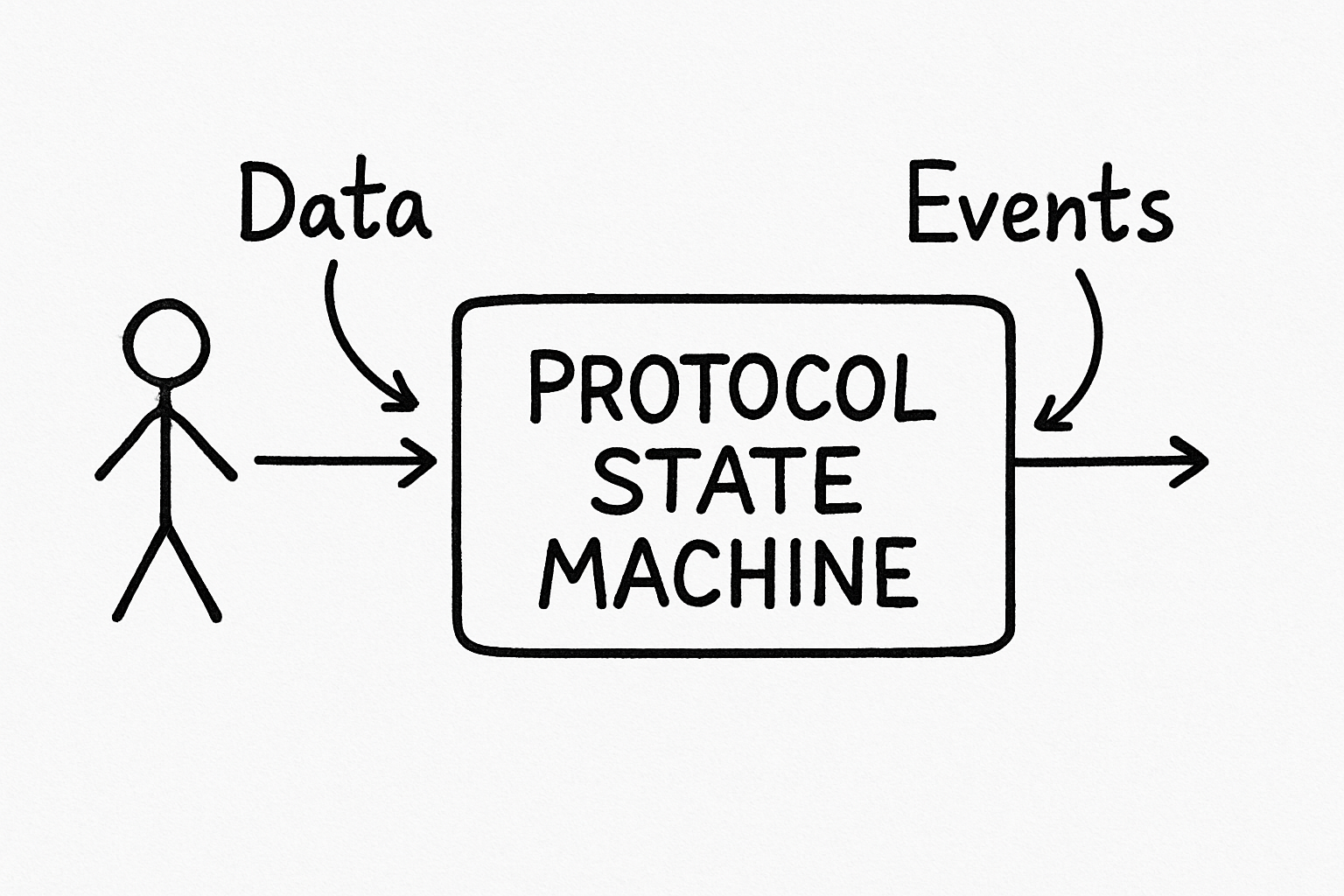
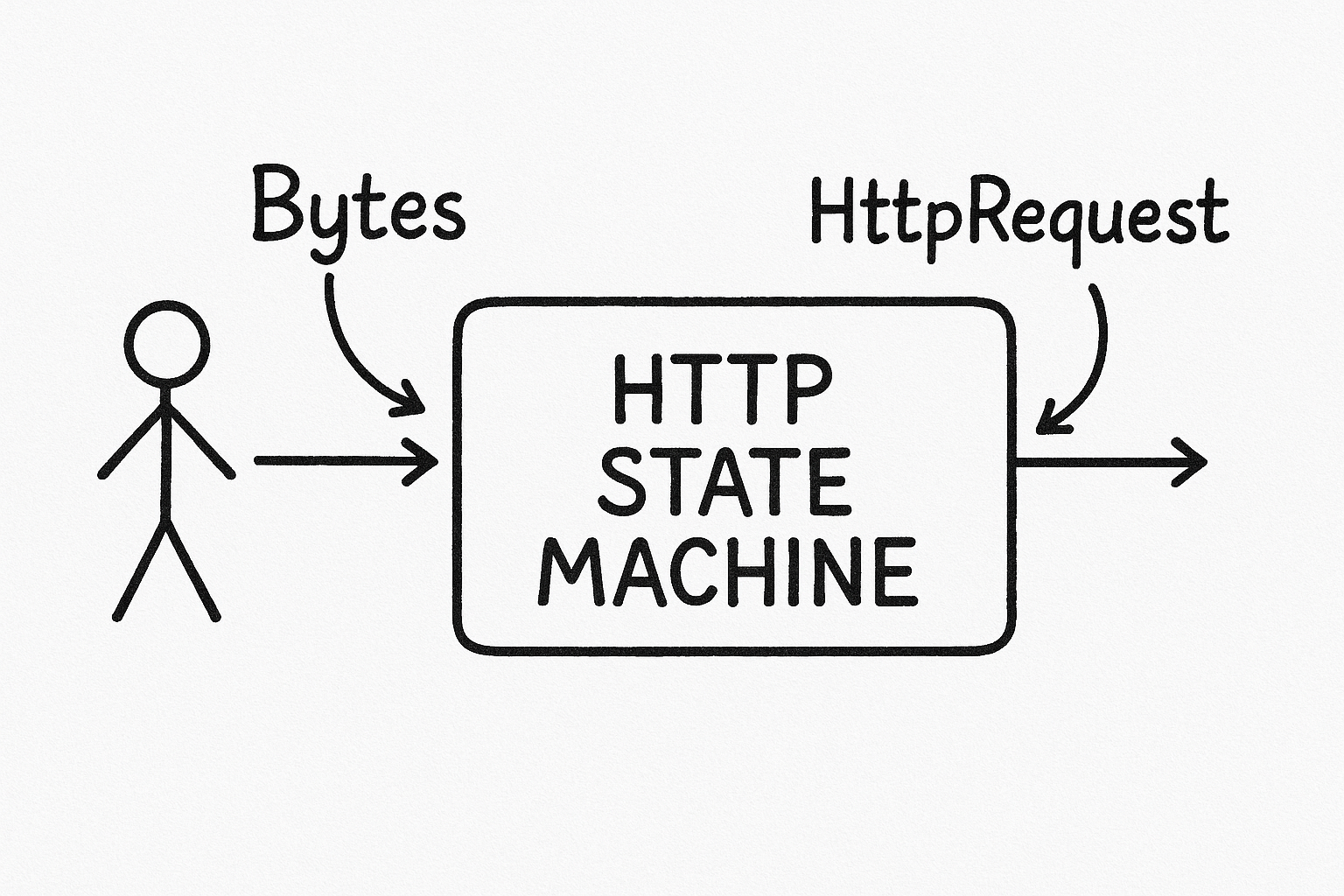
Let’s suppose you are writing an HTTP library, in SansIO model, you will feed the bytes read from the socket to a HTTP State Machine, it parses the raw bytes, converts it in to a valid HTTPRequest object and spits it out.
Now your business logic decides what to do with this HTTPRequest. You draft an appropriate HTTPResponse and feed it to the state machine and out comes the raw bytes to be dispatched to the client.
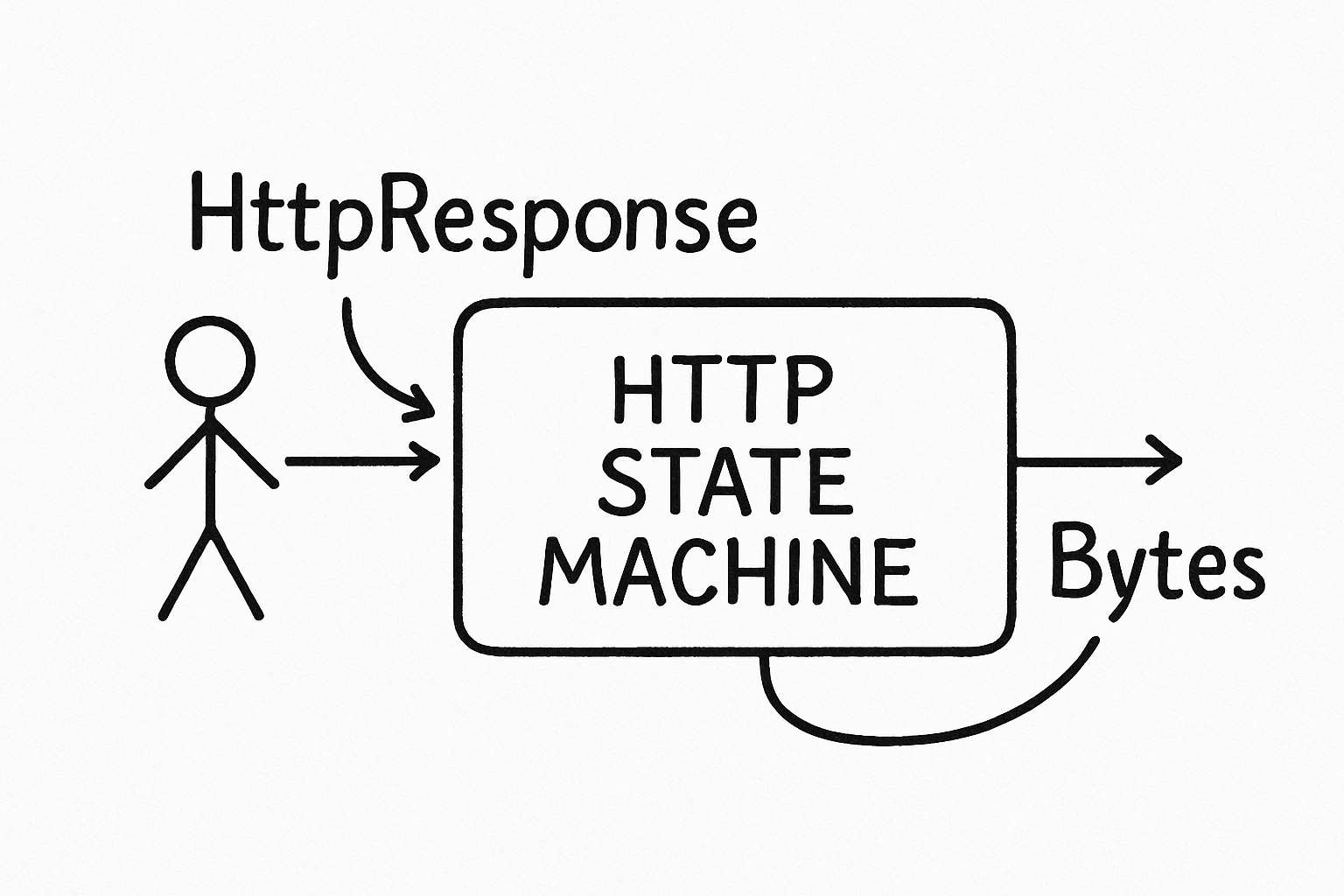
Notice that as a user you only applied your business logic, all the complex protocol stuff are offloaded to the state machine.
Why should you use SansIO?
Universal Adoption
You write the state machine once and it can be compiled and repackage across all platforms. How? Because it is devoid of any async stuff, selectors, IO. It is a loom you can take anywhere from RaspberryPi to iPhones.
Resuability
You don’t like how the business logic is implemented in a project? Perhaps you want to write your own library with your custom needs. It is easy to quickly roll out your own flavour of library by simply extending the protocl state machine.
Endnotes
Many of the OSS projects that has adopted this technique have been a great success. To name a few,
- quinn - QUIC protocol
- str0m - WebRTC stack
- hyper-h2 - HTTP protocol
- matric-nio - Matrix (decentralized communication) client library.